Reagan Has Space Shuttle to Orbit Again to Sleep Lie by Dems
 Canadarm'southward in-flight test during STS-2 | |
| Names | Space Transportation System-2 |
|---|---|
| Mission type | Exam flight |
| Operator | NASA |
| COSPAR ID | 1981-111A |
| SATCAT no. | 12953 |
| Mission elapsing | 5 days (planned) 2days, half-dozenhours, thirteenminutes, 12seconds (achieved) |
| Distance travelled | ane,730,000 km (1,070,000 mi) [1] |
| Orbits completed | 37 |
| Spacecraft properties | |
| Spacecraft | OV-102 |
| Launch mass | 104,647 kg (230,707 lb) |
| Landing mass | 92,650 kg (204,260 lb) |
| Payload mass | 8,517 kg (18,777 lb) |
| Crew | |
| Crew size | 2 |
| Members |
|
| Beginning of mission | |
| Launch engagement | November 12, 1981, 15:09:59UTC |
| Rocket | Infinite Shuttle Columbia (mission 2) |
| Launch site | Kennedy Infinite Center, LC-39A |
| Contractor | Rockwell International |
| End of mission | |
| Landing date | November 14, 1981, 21:23:11UTC |
| Landing site | Edwards Air Strength Base, Track23 |
| Orbital parameters | |
| Reference system | Geocentric orbit |
| Regime | Depression Earth orbit |
| Perigee distance | 222 km (138 mi) |
| Apogee altitude | 231 km (144 mi) |
| Inclination | 38.03° |
| Period | 89.00 minutes |
| Instruments | |
| |
 STS-2 mission patch 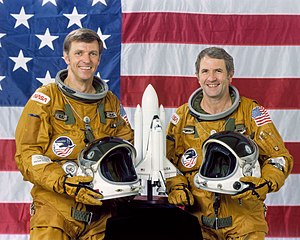 Engle and Truly Space Shuttle programme | |
STS-2 was the 2d Infinite Shuttle mission conducted past NASA, and the 2d flying of the orbiter Columbia. The mission, crewed by Joe H. Engle and Richard H. Truly, launched on November 12, 1981 and landed 2 days afterward November fourteen, 1981.[1] STS-2 marked the kickoff fourth dimension that a crewed, reusable orbital vehicle returned to space.[2] This mission tested the Shuttle Imaging Radar (SIR) as part of the OSTA-one (Office of Space and Terrestrial Applications) payload, along with a wide range of other experiments including the Shuttle robotic arm, normally known as Canadarm.[3] Other experiments or tests included Shuttle Multispectral Infrared Radiometer, Feature Identification and Location Experiment, Measurement of Air Pollution from Satellites, Bounding main Color Experiment, Night/Day optical Survey of Lightning, Heflex Bioengineering Examination, and Aerodynamic Coefficient Identification Package (ACIP).[3] One of the feats accomplished was various tests on the Orbital Maneuvring System (OMS) including starting and restarting the engines while in orbit and various adjustments to its orbit.[iv] The OMS tests likewise aid adjust the Shuttle's orbit for use of the radar.[4] During the mission, President Reagan called the coiffure of STS-2 from Mission Control Center in Houston.[five]
In the early planning stages of the Infinite Shuttle program, STS-two was intended to be a reboost mission for the aging Skylab space station.[note ane] However, such a mission was impeded past delays with the Shuttle's development and the deteriorating orbit of Skylab. Skylab ultimately de-orbited on July 11, 1979, 2 years before the launch of STS-2.[6]
Crew [edit]
Engle had been the original selection as Lunar Module Pilot for Apollo 17, only was bumped in favor of Harrison Schmitt when it became clear that the mission would exist the last lunar landing. As a outcome, both Engle and Truly were rookies during STS-2 (Engle had flown the X-15 higher up 80 km (50 mi) and and then had earned USAF astronaut wings, simply was notwithstanding considered a NASA rookie), constituting the first all-rookie crew since Skylab 4. Engle was the last NASA rookie to command his first flight until Raja Chari in 2021 with SpaceX Crew-iii. Engle and Truly had as well served equally i of the 2 Shuttle crews during the Arroyo and Landing Tests (ALT) program in 1977.
Fill-in coiffure [edit]
This crew would later on fly on STS-4.
Back up coiffure [edit]
- Daniel C. Brandenstein (ascent CAPCOM)
- James F. Buchli[8]
- Terry J. Hart
- Frederick H. Hauck (entry CAPCOM)
- Sally K. Ride (start American female CAPCOM)
Mission summary [edit]

President Reagan talks to the crew of STS-2, in November 1981.
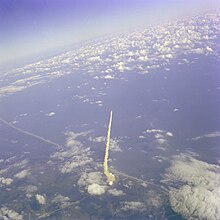

STS-2 on final approach, coming in for its landing after re-entry, on November 14, 1981.
The 2nd Space Shuttle mission launched from Kennedy Infinite Center on November 12, 1981, with liftoff occurring at 15:x:00 UTC, vii months after STS-i. The planned launch time of 12:30UTC was delayed while a faulty data transmitting unit on Columbia was replaced with one from new Space Shuttle Challenger, which had been shipped overnight from the Palmdale, California manufactory where Challenger was still being manufactured.
Originally, the launch had been set for October 9, 1981, but information technology was delayed past a nitrogen tetroxide spill during the loading of the forwards Reaction Command System (RCS) tanks. The spill necessitated the removal, decontamination and reapplication of over 300 thermal tiles. The tiles could be reached from platforms at Launch Complex 39A, allowing the work to take place without destacking Columbia and returning it to the Orbiter Processing Facility (OPF). It was adjacent scheduled for Nov four, 1981, but was again scrubbed when high oil pressures were discovered in two of the three Auxiliary Power Units (APUs) that controlled the orbiter's hydraulic system. That outcome was attributed to hydrazine seepage contaminating the lubrication system in the APUs.
| Attempt | Planned | Result | Turnaround | Reason | Decision point | Weather go (%) | Notes |
|---|---|---|---|---|---|---|---|
| i | 4 Nov 1981, 12:30:00 pm | Scrubbed | — | Technical | (T-31) | APU's ane and 3 lube oil outlet pressure high at 100 to 112 PSIA. Flushed APU's one and three gear boxes and changed clogged filters.[nine] | |
| 2 | 12 Nov 1981, seven:xx:00 am | Delayed | 7 days, eighteen hours, 50 minutes | Technical | Multiplexer/Demultiplexer (MDM) of 3 failed delaying launch by 2 hours 40 minutes while a replacement from the Challenger orbiter was flown in. An boosted 10-minute filibuster was introduced for a confidence review of systems condition. | ||
| iii | 12 Nov 1981, 10:10:00 am | Success | 0 days, 2 hours, 50 minutes |
The flight marked the first time an orbital crewed space vehicle had been re-flown with a 2nd crew. Prior to launch, Columbia spent 103days in the Orbiter Processing Facility. It once again carried the DFI parcel, besides equally the OSTA-l payload (named for the NASA Office of Infinite and Terrestrial Applications), which consisted of a number of remote-sensing instruments mounted on a Spacelab pallet in the payload bay. These instruments, including the Shuttle Imaging Radar-A (SIR-A), successfully carried out remote sensing of Earth'southward resources, environmental quality, and ocean and weather atmospheric condition.[10] In addition, the Canadian-built "Canadarm" Remote Manipulator System (RMS) was successfully operated in all its various operating modes for the offset time.
During the mission, the Mission Control Center was visited by President Ronald Reagan. He was supposed to visit during STS-1, simply was forced to cancel due to an assassination endeavour on March 30, 1981.
Although the STS-2 mission had been planned for a duration of v days, with a few hours a day spent testing the Canadarm, the flying was cut short when 1 of the 3 fuel cells that produced electricity and drinking h2o failed. The mission was shortened to two days, and the Canadarm tests were canceled. The coiffure stayed awake during a scheduled sleep menstruation and tested the arm anyway, working during the loss of bespeak (LOS) periods when they were non in contact with Mission Control.[eleven] The deorbit and reentry phase of this mission differed from STS-ane, in that while the first shuttle entry was flown every bit a "middle of the route" examination of the automatic guidance, the success of that mission allowed for the STS-two crew to explore the stability margins of the vehicle'south operation. Twenty-nine planned Programmed Test Inputs (PTIs) were manually flown in the Control Stick Steering (CSS) style, with Engle making employ of his past feel in the X-xv. These PTIs provided useful data for subsequent engineering modifications.[11] Contrary to the interviewer's assertion in a JSC Oral history conversation with Engle, he mitt flew manoeuvres throughout the entire entry speed range, but non for the unabridged duration.[12] As a consequence of STS-1 entry anomalies, the first coil manoeuvre was flown manually and the elevon scheduling was adjusted to offload the torso flap.
Hunt 1 crewed past astronauts "Hoot" Gibson and Kathy Sullivan escorted Columbia on final approach. Landing took identify on Runway23 at Edwards Air Force Base at 21:23UTC, on November 14, 1981, after a 37-orbit flying which covered a total of i,730,000 km (one,070,000 mi) over the grade of 2days, half-dozenhours, xiiiminutes and 12seconds.[ane]
Despite the truncated flight, more than than 90% of the mission'south objectives were accomplished.[11] Moreover, modifications of the water sound suppression organization at the pad, to absorb the solid rocket booster overpressure wave during launch, were effective; no tiles were lost and only 12 were damaged. Columbia was flown back to the Kennedy Infinite Heart on November 25, 1981.
STS-2 was the first Infinite Shuttle flight where O-band blow-by was observed. After the damage was discovered, another O-ring was intentionally damaged to a further degree. It was then put through a flight simulation at three times the flight pressure. It survived the test, and was endorsed every bit flightworthy. This same problem would occur on xiv more Shuttle flights, before contributing to the loss of orbiter Challenger in 1986.
STS-2 was the last shuttle flight to have its external fuel tank (ET) painted white. In an attempt to reduce the Shuttle's overall weight, STS-3 and all subsequent missions used an unpainted tank, saving approximately 272 kg (600 lb) of launch weight.[xiii] This lack of paint gave the ET a distinctive orange-brownish colour, which eventually became emblematic of the Space Shuttle.
Decades afterward[ when? ] some[ who? ] questioned if the white paint might have prevented the ice-soaked foam shedding result that led to the loss of Columbia ii decades later on.[14] [15]
Experiments or tests [edit]
STS-ii payloads or experiments:[3]
- OSTA-1 [three]
- Shuttle Imaging Radar
- SRMS, the Shuttle robotic arm, also known as Canadarm
- Shuttle Multispectral Infrared Radiometer
- Feature Identification and Location Experiment
- Measurement of Air Pollution from Satellites
- Bounding main Color Experiment
- Night/24-hour interval optical Survey of Lightning
- Heflex Bioengineering Test
- Aerodynamic Coefficient Identification Package (ACIP)
They likewise tested the OMS engines.[four]
Mission insignia [edit]
The mission patch notes the names of the mission's ii coiffure members, and includes an image of a bald hawkeye, the national bird of the United states of america, busy with the colors of the U.S. flag.
Wake-up calls [edit]
NASA began a tradition of playing music to astronauts during the Project Gemini, and starting time used music to wake up a flight coiffure during Apollo 15.[xvi]
| Flight Twenty-four hour period | Song | Creative person/Composer |
|---|---|---|
| Day 2 | "Pigs in Infinite" | The Muppets |
| Day 3 | "Columbia, Gem of the Ocean" | Flight Operations Advisers grouping Contraband |
Gallery [edit]
-
Columbia on launchpad
See also [edit]
- List of human spaceflights
- List of Space Shuttle missions
- Shuttle Radar Topography Mission
Notes [edit]
- ^ Fred Haise and Jack Lousma were named as the prime crew for the original STS-2 mission, with Vance D. Brand and C. Gordon Fullerton as backups
References [edit]
- ^ a b c "NASA – STS-2". NASA. Retrieved May ix, 2008.
 This commodity incorporates text from this source, which is in the public domain .
 - ^ The uncrewed Gemini ii suborbital capsule was reused in another uncrewed, suborbital test for the Manned Orbiting Laboratory (MOL) project after significant refurbishment. Also, two Ten-15 airframes (flown by STS-2 Commander Joe Engle) were reused on several suborbital space missions.
- ^ a b c d Becker, Joachim. "Spaceflight mission written report: STS-two". spacefacts.de . Retrieved December thirty, 2017.
- ^ a b c Evans, Ben (November 12, 2016). "Flying a Used Space Shuttle: 35 Years Since the Short Mission of STS-2 (Office ane)". Retrieved Dec 30, 2017.
- ^ Wilson, Jim. "NASA - Remembering Ronald Reagan". NASA. Retrieved Dec 30, 2017. This article incorporates text from this source, which is in the public domain .
- ^ Shayler, David (2001). Skylab. Berlin: Springer. p. 311. ISBN1-85233-407-X.
- ^ "STS-2". NASA. Retrieved August 1, 2018. This article incorporates text from this source, which is in the public domain .
- ^ Mission transcript Internet Archive Retrieved 13 November 2012
- ^ "Space Shuttle Mission Summary" (PDF). NASA Johnson Infinite Center. This commodity incorporates text from this source, which is in the public domain .
- ^ "SIR-A: 1982". NASA. Archived from the original on Feb 8, 1997. Retrieved June 22, 2013. This article incorporates text from this source, which is in the public domain .
- ^ a b c "[1]" NASA Johnson Space Eye Oral History Project 3 June 2004 Retrieved 17 July 2013 This commodity incorporates text from this source, which is in the public domain .
- ^ Dennis R. Jenkins (2017). Space Shuttle: Developing an Icon 1972-2013. Speciality Printing. ISBN9781580072496.
- ^ NASA "NASA Takes Commitment of 100th Space Shuttle External Tank" Archived March 11, 2007, at the Wayback Automobile Printing release pp.99–193. 16 Baronial 1999. Retrieved 17 July 2013 This article incorporates text from this source, which is in the public domain .
- ^ Malik, Tariq (Apr 12, 2006), Columbia's White External Fuel Tanks , retrieved December xxx, 2017
- ^ "Space Shuttle Mission Summary" (PDF). NASA Johnson Space Middle. This article incorporates text from this source, which is in the public domain .
- ^ Fries, Colin (June 25, 2007). "Chronology of Wakeup Calls" (PDF). NASA. Retrieved Baronial 13, 2007. This article incorporates text from this source, which is in the public domain .
External links [edit]
 | Wikimedia Eatables has media related to STS-2. |
- STS-2 mission summary. NASA.
- STS-2 video highlights Archived January 29, 2010, at the Wayback Auto. NSS.
- "Space Shuttle Canadarm Robotic Arm Marks 25 Years in Space". NASA. 2006.
stewartcittly1948.blogspot.com
Source: https://en.wikipedia.org/wiki/STS-2
0 Response to "Reagan Has Space Shuttle to Orbit Again to Sleep Lie by Dems"
Post a Comment